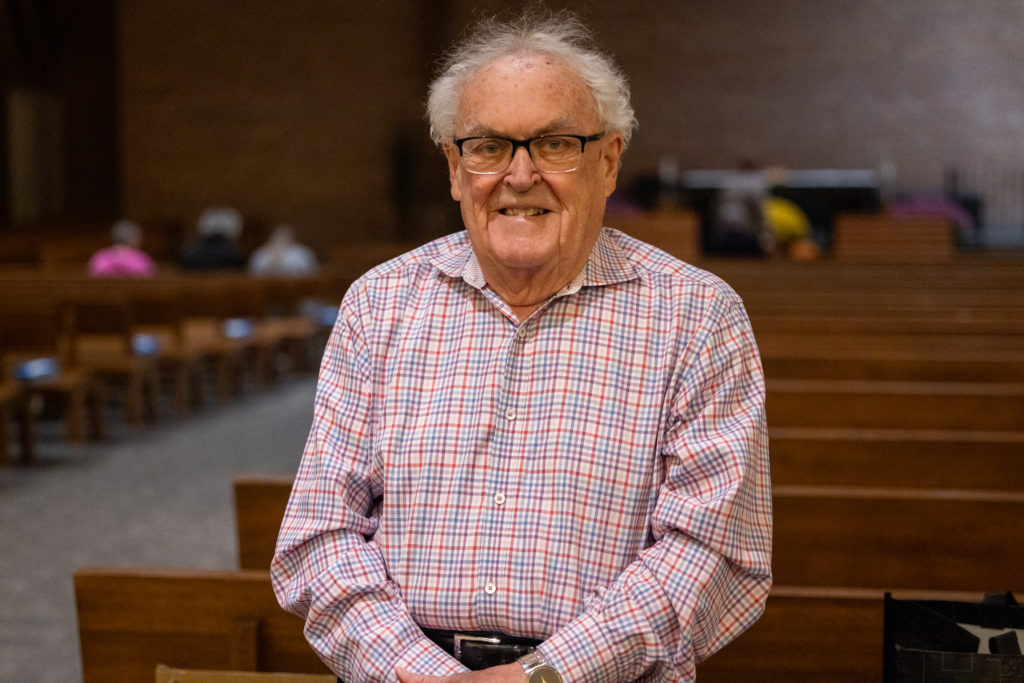
Father Charles T. Rubey has spent his career fighting the stigma surrounding suicide. In the process, he has welcomed, supported, witnessed, and healed thousands of survivors of suicide loss through his founding of Loving Outreach to Survivors of Suicide (LOSS) for Catholic Charities of the Archdiocese of Chicago.
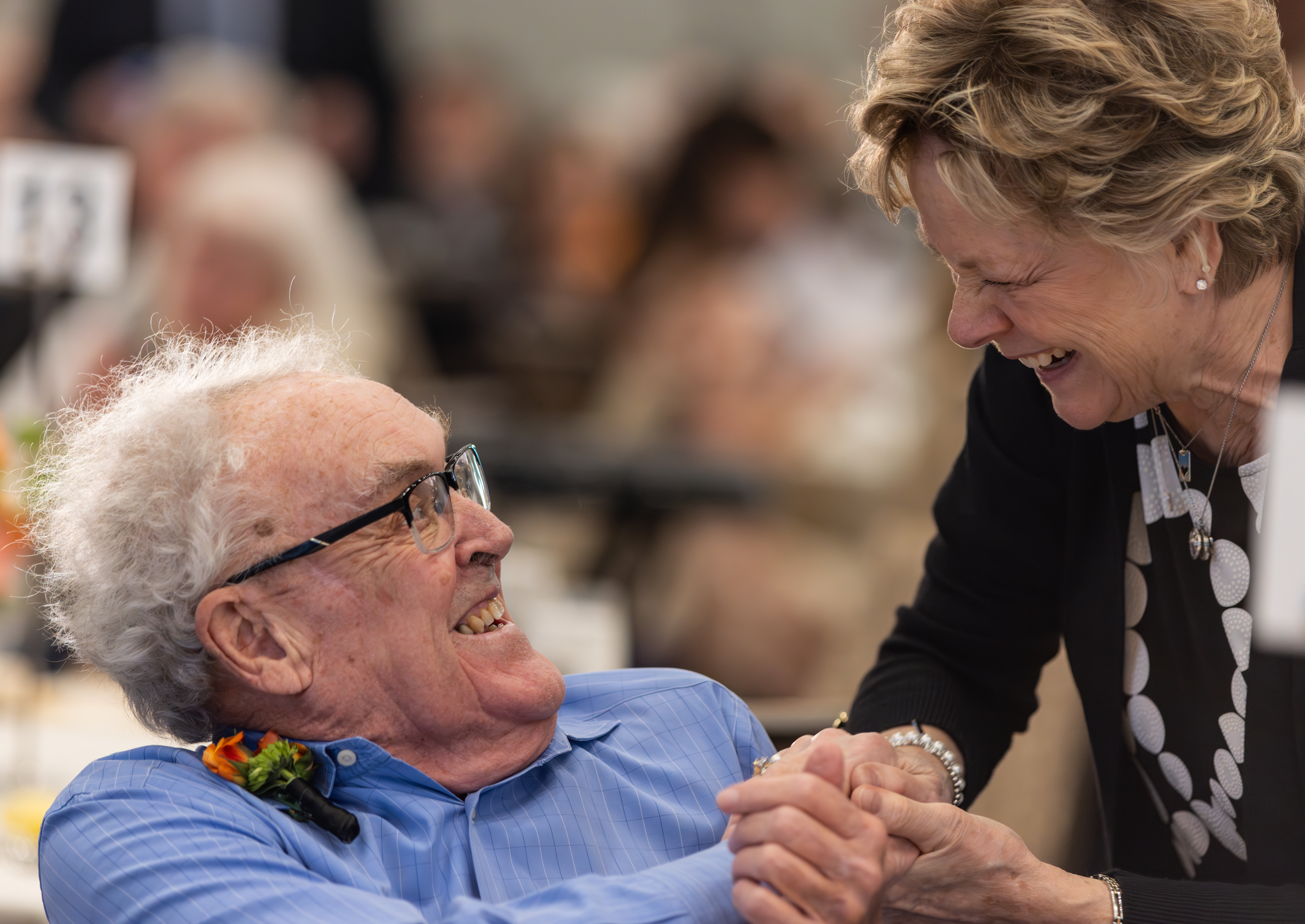
On April 26, 2026, Father Rubey will celebrate 60 years as a priest, and a ministry that has touched the souls of so many who call him a dear friend. From his humble beginnings as a 26-year-old parish priest at the former Little Flower Church in Chicago’s Auburn Gresham neighborhood, Father Rubey has grown to be a legendary spiritual leader for serving those hoping to find joy and purpose after a suicide loss.
“We all have the same story — he changed our lives,” said Monica Pedersen, who lost her twin brother to suicide at age 16. She and her family found comfort and connection through LOSS, and a life-long friend and counsel in Father Rubey. “He was the voice in our heads to move forward. He’s our gift — his vision, his courage, his dedication. We need 160 years of Father Rubey.
“I cannot imagine what my life would have been like if I didn’t have Father Rubey,” said Monica, who will once again host the 35th annual Blossoms of Hope brunch fundraiser planned for April 26, 2026, at the Westin Chicago Lombard.
And Father Rubey can’t imagine what his life would have been like without LOSS.
His early years
Charlie, as he was known as a child, grew up in Des Plaines. His mother, a native of Ireland, and his father, who passed before he was ordained, along with his sister, attended St. Mary’s Church. It was there at the age of 12, he discovered his vocation.
“I was an altar boy when I decided I’d like to become a priest,” Father Rubey said. He would go on to spend five years at Quigley and another seven years at St. Mary of the Lake Seminary in Mundelein.
“I liked being a priest, I never really thought of leaving,” he said.
During his first assignment at Little Flower Church, he connected with many in the community, serving as an officiant to dozens of marriages for couples who still keep in touch. When a fellow parish priest introduced him to Catholic Charities, he found another calling — ministering to the men living on Skid Row along Madison Street in Chicago. For six years, he lent his ear to those who needed to talk, and words of support for those struggling to overcome alcoholism.
Father Rubey’s compassionate care was recognized and soon needed elsewhere. In the winter of 1979, Rev. Charles T. Rubey met with three couples to offer compassion and support after they lost a child to suicide. In the late 1970s, suicide was poorly understood, and there was little organized support for families experiencing this traumatic loss, leaving many survivors in the Catholic community feeling ostracized. This was Father Rubey’s first grief support group, and the three couples eventually became known as the founding families of LOSS (Loving Outreach to Survivors of Suicide). One group led to a second and third, and word spread across the Chicago metropolitan area.
“There was shame and embarrassment because there was a stigma attached to suicide,” Father Rubey said, with many parents asking themselves, “What did I do as a parent to cause this, to make my child take their life?”
After 47 years, LOSS continues to bring people together, creating a community of survivors who support each other. Individual counseling and support groups are held in person across Cook and Lake counties, and also online. LOSS hosts support groups for spouses, parents, Spanish speakers, families of first responders, and others, and a writing group. The groups are led by seven clinicians and 43 volunteer facilitators who are survivors. Deborah Major, who has worked alongside Father Rubey for 16 years, is the director of the program.
“I’m always amazed that he had this very open and nonjudgmental view of people who had lost their children or other relatives to suicide,” Deborah said. “He had that view way back in the ‘70s when suicide was even more highly stigmatized than it is today. Survivors must have felt like ‘someone understands what we’re going through and it’s a priest no less.’”
In his experience, Father Rubey discovered some priests were not always very compassionate. He remembers about 40 years ago when he received consecutive calls from families who had sought solace with their parish priest, who told them, “You know your loved one is in hell.”
“As a result of that, I developed a ritual to bless the place where the person took their life,” Father Rubey said. “I’ve been on railroad tracks and woods, that’s where they were engulfed by God.
“Since then, the church has changed its whole attitude about suicide and began allowing funeral masses, Mass of Christian burial. It’s no longer a sin.”
LOSS welcomes and embraces
Monica remembers her first LOSS meeting with her parents in 1987. It was the first time she was in a room full of people she could relate to — fellow survivors.
“We go in with no hope, LOSS gives us hope,” she said. “Father Rubey gave us the tools to get through the day, get through the hour, and get through the moment. He gave us permission to have our feelings and express them.
“You’re suffering this great loss, and you feel alone because your community is avoiding you because they don’t know what to say,” Monica said. “Father Rubey wasn’t avoiding us; he was embracing us.”
She said he encouraged survivors to talk; he listened and gave them permission to have feelings. He helped them overcome their guilt.
“I always thought it was my fault. He was my brother and I was 16,” Monica said. “Father Rubey was that voice, ‘Your brother died of mental illness,’ and when he said it, I believed him. When he said, ‘You will learn to live with the pain,’ it was having someone communicate in a way, believe, listen, and hear, that started me on my path of healing. He’s never stopped being there.”
Monica, who participated in LOSS support groups for four years and another four years as a group facilitator, said she was always amazed that Father Rubey, who had not lost an immediate family member to suicide, always knew what to say. She believes that’s the work of the Holy Spirit.
Understanding LOSS
Father Rubey and LOSS staff help survivors understand their grief experience and realize there is nothing they did or said that caused their loved one’s death. They are very honest in dealing with survivors and try to help them understand the psychological pain their loved one was experiencing and the range of painful emotions they now feel in the wake of loss.
“Mental illness, it can be fatal,” Father Rubey said. “Survivors have to learn to live with the mystery — not necessarily understand it but learn to accept that you can’t change it. The loved one is at peace — they’re with God. I believe that’s holy and sacred. You never want to forget your loved one. You want to remember them. They weren’t bad people. They would not want to impose their pain on their loved ones, but they could no longer tolerate that pain, so for the loved one, it has ended.”
Father Rubey said his own faith has been challenged by his work with survivors of suicide who ask him, “Why would God allow this?”
“To me, that’s all part of the mystery — the holy mystery,” Father Rubey said. “There are no magical words to take away the pain. You give them hope, you’re not going to feel this way for the rest of your life. You’ll learn to smile again, laugh again, and enjoy life.”
LOSS participants are encouraged to create quilt squares to memorialize loved ones with photos, drawings, and words. The program has 24 large, memorial quilts that are displayed at the annual Blossoms of Hope brunch.
“It was Father Rubey’s idea to create memorial quilts to humanize and destigmatize suicide loss,” Deborah said. “This has been his life’s mission, and a cornerstone of his service. He’s helped a lot of people understand that even though this is a horrible tragedy, they are all still children of God. He’s helped many people free themselves of that sense of being ostracized, which is very important.”
Father Rubey has been working closely with Catholic Cemeteries to develop a memorial garden that he hopes will bring peace and healing to those whose lives have been impacted by suicide at Queen of Heaven Catholic Cemetery & Mausoleums in Hillside, Illinois. A dedication ceremony is planned for May.
“My life has been transformed in working with the LOSS program, and my faith has been deepened,” Father Rubey said. “The LOSS program has been a real source of strength for me.”
Related Stories
-
Celebration of Giving – A Christmas Tradition for the Kastenholz Family
Many people wonder how a program as large and complex as Catholic Charities’ Celebration of Giving (COG) has thrived for more than 75 years....
-
Five sisters enrich their community with cooking, faith, and love
As the crackling of spices and chicken sends a mouthwatering aroma across the common areas at the Ozanam Village senior residence, people can’t help...
-
Father Rubey honored at LOSS brunch for 60 years of service
For nearly five decades, Father Charles T. Rubey has been a trusted source of suicide grief support for families facing one of life’s most...